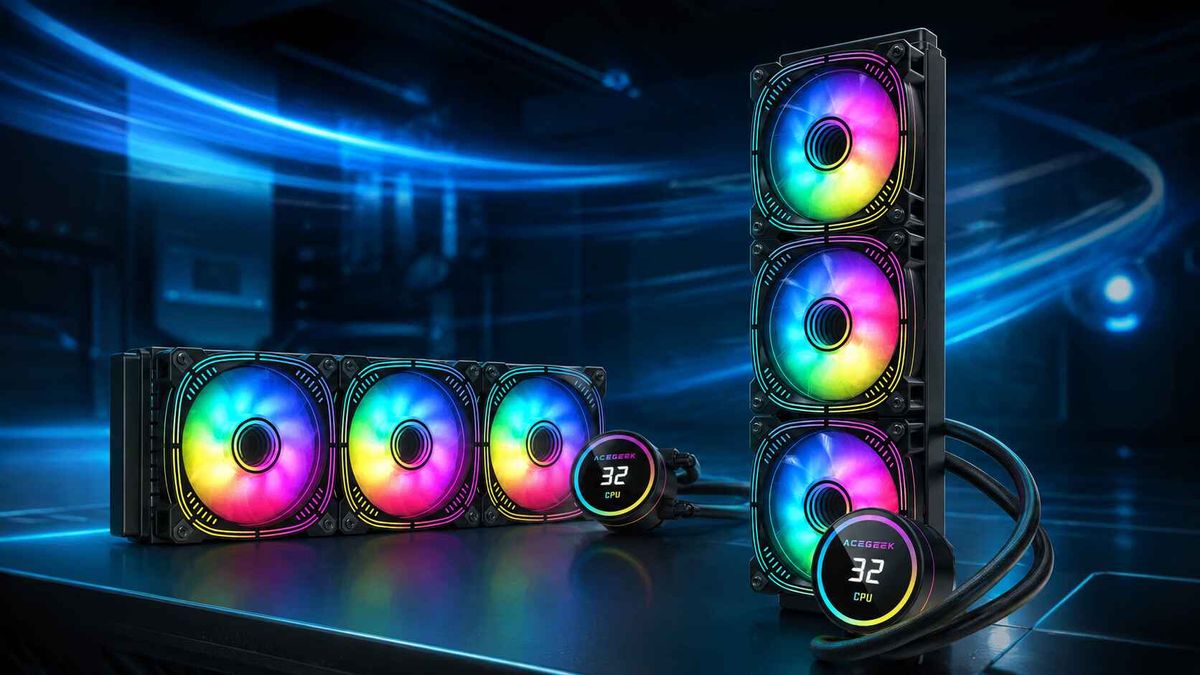
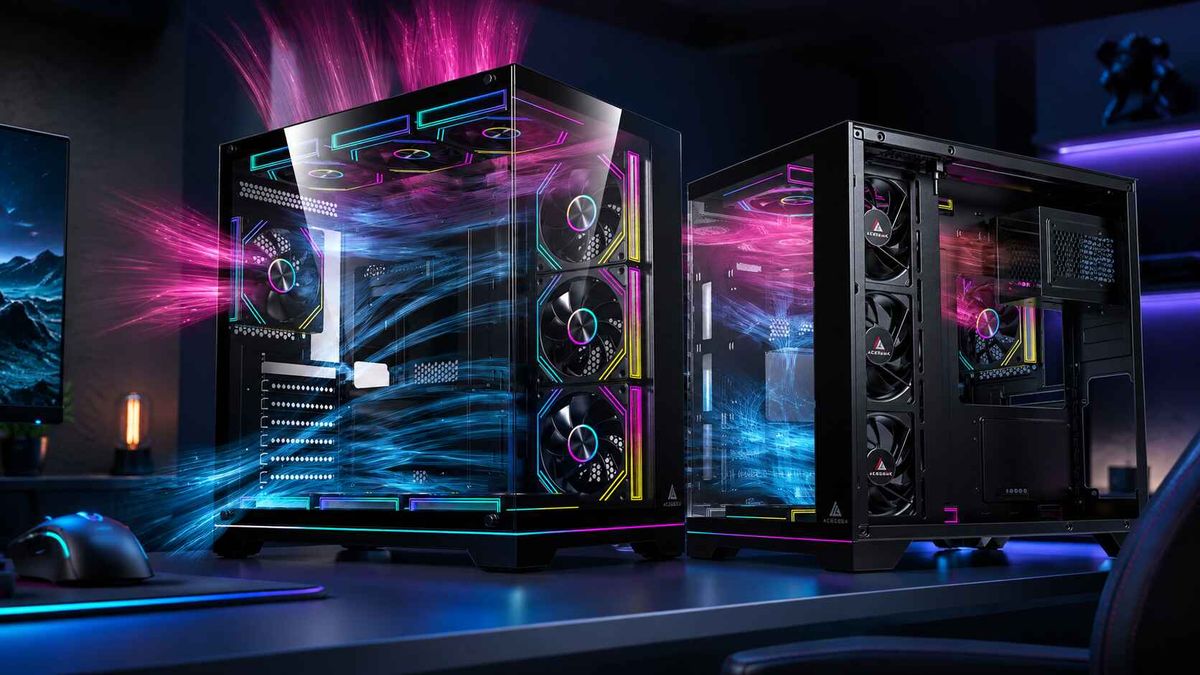
Dual-Chamber vs Traditional PC Cases: What Actually Changes?
Looks can deceive.
A dual chamber PC case moves the power supply, storage, and most cable bulk into a second compartment, but that structural change also alters chassis width, intake placement, radiator strategy, maintenance access, and the way builders misread thermal performance.
So is it genuinely better, or merely easier to photograph?
My blunt answer is this: a dual-chamber layout is usually better for presentation and component separation, while a traditional PC case is often simpler, narrower, cheaper to equip with fans, and easier to understand thermally. Neither design automatically wins on temperature.
The chamber count is not the result. It is the starting geometry.
Before choosing either format, I would first confirm motherboard size, graphics-card dimensions, CPU cooler height, radiator thickness, PSU length, and desk space using ACEGEEK’s guide on how to choose the right PC case for your build. A case can look enormous and still fail one inconvenient measurement.
The Split Is Structural, Not Magical
A traditional or single chamber PC case keeps the motherboard, graphics card, power supply, storage, and most cables within one main enclosure. A PSU shroud may hide the power supply, but the components still share broadly the same internal volume.
A dual chamber PC case divides those functions.
The visible chamber normally holds the motherboard, GPU, memory, CPU cooler, fans, and lighting. The second chamber, positioned behind or beside it, usually contains the PSU, drive cages, cable bundles, fan hubs, and ARGB controllers.
That separation creates three immediate effects.
First, the main chamber looks much cleaner. Second, the case becomes wider because an ATX power supply is now sitting beside the motherboard rather than below it. Third, the familiar front-to-back airflow path may disappear, especially when a glass front panel replaces conventional intake fans.
This is where buyers get careless. They see an empty main chamber and assume air must move freely through it. But empty volume is not airflow. Air still needs a low-resistance entrance, a useful route across hot components, and an exit that does not send the same heated air back toward the GPU.
The hard truth? A beautiful empty chamber can still be a warm box.
Dual-Chamber vs Traditional PC Case: The Real Comparison
Design factorDual-chamber PC caseTraditional PC caseInternal structurePSU, drives, and cables occupy a separate compartmentMost hardware shares one main enclosureTypical intake pathSide and bottom intakeFront intakeTypical exhaust pathTop and rear exhaustRear and top exhaustCable managementMore hiding space and controller roomLess depth, but often simpler routingCase footprintUsually widerUsually narrowerGPU coolingStrong when bottom intake is unrestrictedStrong when front intake reaches the GPU directlyRadiator placementOften supports side, top, and bottom positionsUsually front and top positionsAir-cooler compatibilityGood, but glass layouts may lack direct front airflowOften excellent with a mesh front and rear exhaustBuild presentationExcellent for RGB and panoramic hardware displaysDepends heavily on side-panel designMaintenanceMore panels, filters, hubs, and hidden wiringFewer zones and usually easier fault tracingFan requirementFrequently needs several separately purchased fansOften works well with three sensible fansBest useShowcase builds, complex liquid cooling, cable-heavy systemsPractical gaming PCs, air-cooled builds, smaller desks
A dual-chamber case is therefore not a direct upgrade from a traditional case. It is a different allocation of space.
You gain width, hidden utility volume, and mounting freedom. You may lose direct front intake, desk space, simplicity, and the ability to achieve good results with only two intake fans and one exhaust fan.
Airflow Changes Because Fan Geography Changes
Traditional Cases Usually Offer a Straight Air Path
The classic airflow arrangement is easy to explain: cool air enters through the front, crosses the graphics card and CPU area, and leaves through the rear or roof.
Boring works.
A mesh-front traditional tower with two or three intake fans can create a direct air path without requiring the builder to understand complicated crossflow. A tower CPU cooler can face the rear exhaust. The GPU receives air from the lower front fan. Hot air moves toward predictable exits.
Intel’s 2008 Thermally Advantaged Chassis Design Guide targeted a rise of no more than 5°C between external ambient air and the processor heatsink inlet in its reference tower design. More importantly, Intel emphasized that vent size, vent position, exhaust restriction, and airflow balance determine whether all components receive adequate cooling. The document is old, but the physics has not retired.
A traditional tower can still fail badly. A sealed glass front, tiny decorative vents, a clogged filter, or a drive cage blocking the lower intake can destroy that supposedly simple path. ACEGEEK’s guide to building a high-airflow PC without overspending explains why adding more fans cannot rescue an intake opening that barely exists.
Dual-Chamber Cases Replace Front Intake With Crossflow
Most panoramic dual-chamber designs use side intake, bottom intake, or both. Air enters beside the motherboard and underneath the graphics card, then exits through the roof and rear.
That can work exceptionally well.
Bottom fans can feed an open-air GPU directly. Side fans can supply the CPU cooler or side-mounted radiator. Top exhaust fans can evacuate the combined heat. The PSU may also draw its own outside air through the rear chamber, reducing its interaction with the main hardware zone.
But crossflow requires planning.
Side intake air travels across the width of the case rather than along its length. A large GPU can divide the upper and lower air zones. Bottom fans may sit too close to a desk or dense filter. A side radiator used as intake can send warmed air toward the motherboard and graphics card.
GamersNexus demonstrated how sensitive this geometry can be in its Lian Li O11 Dynamic XL thermal testing. With two 140 mm bottom intakes and one rear exhaust, CPU temperature reached 53.8°C delta over ambient. Three 120 mm side-intake fans improved that result to 50.2°C, while adding a rear exhaust lowered it again to 48.7°C. GPU temperature remained particularly strong at roughly 46.7°C delta in the bottom-intake configuration.
Those numbers do not prove that every dual-chamber case behaves identically. They prove something more useful: fan location can change the outcome by several degrees without changing the case itself.
The label means less than the route.
Modern GPU Heat Makes the Difference Harder to Ignore
The comparison becomes more serious when a flagship GPU enters the build.
According to NVIDIA’s official GeForce RTX 5090 specifications, the Founders Edition is 304 mm long, carries 32 GB of GDDR7 memory, has a 575 W total graphics power rating, and is paired with a 1,000 W recommended system-power figure. NVIDIA launched it with a starting price of $1,999.
That is not a minor heat source sitting under a CPU cooler. It is a 575 W device occupying the center of the chassis.
Add a high-power processor, motherboard voltage-regulation losses, memory, SSDs, pumps, and fans, and an enthusiast system can become an 800 W-class heat-management problem under combined workloads. Every watt consumed eventually becomes heat that the room and chassis must absorb.
This changes how I judge dual chamber PC case airflow.
I do not care that the case supports ten fans on paper. I care whether at least two or three intakes deliver room-temperature air directly to the GPU without a radiator, decorative bracket, cable bundle, or restrictive filter standing in the way.
A traditional mesh tower may handle that job through lower front intake. A dual-chamber design may do it better through three bottom fans. Both are valid.
But “supports ten fans” is not a thermal result. It is a collection of screw holes.
The issue also affects a large market. Reuters reported that global PC shipments reached 62.7 million units in the first quarter of 2025, a 9.4% year-over-year increase, although tariff-related inventory timing contributed to the rise. That statistic does not tell us which chassis wins, but it shows why seemingly small enclosure decisions are repeated across millions of systems.
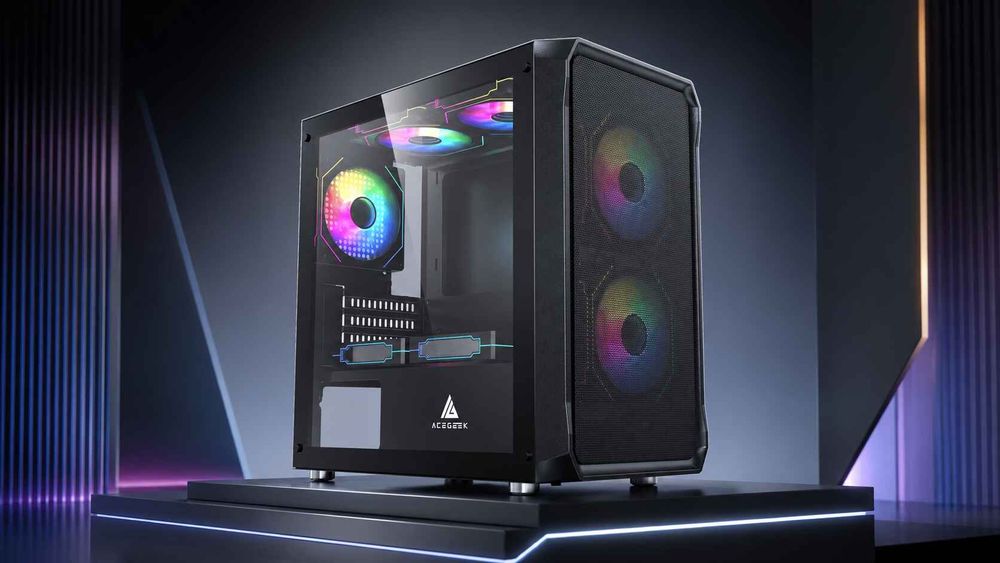
Cable Management Improves, Then Finds a New Way to Fail
The strongest practical argument for a dual-chamber case is cable management.
Moving the PSU behind the motherboard gives builders somewhere to place:
The 24-pin motherboard cable
EPS CPU power cables
GPU power cables
SATA power chains
Fan hubs
ARGB controllers
Front-I/O wiring
Pump and temperature-sensor leads
Excess modular PSU cable length
The visible chamber becomes cleaner, and fewer cables cross the intake path. That is a real benefit, especially in builds using nine or more fans, multiple lighting controllers, storage drives, an LCD AIO, and a 12V-2x6 GPU cable.
But hidden does not mean managed.
I have seen the same mistake repeatedly in layout audits: every wire gets pushed into the rear chamber because the steel cover conceals it. The side panel then requires pressure to close. SATA connectors bend. Controller plugs become inaccessible. One failed fan turns into a thirty-minute cable-tracing exercise.
That is not cable management. It is cable storage.
A good dual-chamber layout needs usable rear depth, tie-down points, separate cable lanes, controller mounting locations, and enough clearance for connectors rather than cables alone. A 25 mm-deep bundle may need considerably more room once two connectors overlap.
Wider panoramic cases can provide useful examples of this space allocation. The ACEGEEK Mercury R425 panoramic ATX case measures 425 × 280 × 420 mm and lists 410 mm of GPU clearance, three side fan mounts, three bottom mounts, three top mounts, and support for 360 mm AIO radiators at the side or top. The 280 mm case width is not wasted decoration; width is what allows side-mounted cooling and rear utility space to coexist.
Traditional cases offer less hiding room, but the routing can be more disciplined because builders cannot bury unlimited cable bulk. Fewer fan zones also mean fewer splitters, hubs, and lighting leads.
Sometimes a smaller mess is the better system.
Radiator Placement Becomes More Flexible—and More Political
Traditional cases usually place radiators at the front or top. Dual-chamber cases frequently add a full side mount and, in some models, a bottom radiator position.
More options sound better. They also create more ways to preheat the wrong component.
Side Intake Can Favor the CPU
A side-mounted intake radiator receives cool room air, which can reduce coolant and CPU temperatures. The tradeoff is that the radiator’s heated exhaust enters the main chamber.
Where does that warmer air go?
In a dual-chamber case with independent bottom intake, the GPU may still receive fresh air. That is a defensible arrangement: bottom fans feed the GPU, side radiator feeds the CPU, and top fans exhaust the mixture.
Without bottom intake, the GPU may be forced to breathe through the side radiator’s heated output. The CPU number looks attractive while GPU temperature, hotspot temperature, and fan noise quietly rise.
ACEGEEK’s analysis of side-mounting an AIO radiator reaches the same practical conclusion: side intake makes sense when the graphics card has a separate cool-air source. A standard 27–30 mm radiator combined with 25 mm fans already creates a 52–55 mm stack before cable bends, screw heads, and panel clearance are counted.
Top Exhaust Usually Protects System Balance
A top-mounted exhaust radiator uses warmer internal air, so CPU temperature may be slightly higher. But it removes CPU heat from the case rather than injecting it into the GPU zone.
For gaming-first systems, I often accept a few additional CPU degrees to protect a graphics card dissipating 300 W, 450 W, or 575 W for extended periods.
CPU temperature is not the only scoreboard.
For high-power liquid-cooled systems, ACEGEEK’s guide on how to plan airflow for a dual-radiator PC build provides a useful planning model. Side intake plus top exhaust is particularly effective in dual-chamber cases when bottom fans separately feed the GPU.
A conventional tower still has an advantage in simplicity. Front intake plus top exhaust is easy to visualize. A dual-chamber build may involve side intake, bottom intake, top exhaust, rear exhaust, radiator resistance, filters, and a GPU acting as an airflow wall.
Flexibility charges interest.
Noise Depends on Restriction, Not Chamber Count
Dual-chamber cases are sometimes assumed to be quieter because they have more internal volume and can hold more fans.
That assumption is weak.
A case with nine fans running at 700 RPM may be quieter than a traditional tower with three fans running at 1,500 RPM. But a panoramic case with dense side filters, narrow bottom clearance, and glass near the intake may force those nine fans to work harder than expected.
The relevant questions are:
How much open area does the intake provide? How restrictive is the filter? How close are the fan blades to a panel? Can larger fans be used? Does the fan curve react to GPU temperature or only CPU temperature?
Intel’s power-supply design guidance states that larger, unobstructed intake and exhaust openings reduce airflow impedance and can reduce acoustic noise. It also warns that poorly located venting can let air bypass the parts that need it. That principle applies directly to case design: a large opening in the wrong place is not necessarily useful.
A traditional mesh-front case often wins the noise battle because it requires less fan pressure to move a given amount of air. A well-designed dual-chamber case can match or beat it, but the intake surfaces must be honest.
Glass does not move air.
Which PC Case Style Should You Actually Buy?
Choose a Dual-Chamber PC Case When Presentation Matters
A dual chamber PC case makes sense when you want a panoramic build, extensive ARGB hardware, side-mounted cooling, multiple controllers, hidden storage, or enough rear space to manage a complicated cable system.
It is also compelling for custom liquid cooling. Separate utility space can hold pumps, reservoirs, drive cages, cable runs, and radiator hardware without crowding the visible motherboard area.
But budget for the full system. Many showcase cases ship without enough fans to use their intended airflow pattern. The purchase price may be only the beginning.
Choose a Traditional PC Case When Direct Airflow Matters More
A traditional case is often the better decision for a tower air cooler, a smaller desk, a three-fan cooling plan, frequent transport, or a build where function matters more than panoramic visibility.
A strong mesh-front ATX mid tower remains difficult to beat. Two or three front intakes, one rear exhaust, a clear GPU path, and a sensible fan curve can cool serious hardware without turning the build into an airflow experiment.
I would also choose traditional construction for many first-time builders. Fewer chambers mean fewer decisions, fewer hidden wires, and fewer opportunities to reverse six fans because the finished build looked correct from the glass side.
Simple is not outdated.
Judge the Exact Case, Not the Category
This is the final rule.
There are excellent dual-chamber cases and terrible ones. There are exceptional traditional towers and sealed front-panel ovens. Comparing categories can narrow the decision, but the exact vent geometry, filters, clearances, panel spacing, fan support, and cable depth decide the outcome.
Use the category as a filter. Use measurements as evidence.
FAQs
What is a dual-chamber PC case?
A dual-chamber PC case is a chassis that separates the motherboard, graphics card, and visible cooling hardware from the power supply, storage drives, and most cable bulk, placing those support components in a second compartment beside or behind the main chamber to create a cleaner build and different airflow geometry.
The arrangement is common in panoramic and showcase cases because it exposes the main hardware while hiding utility components. It also commonly enables side-mounted radiators and bottom GPU intake.
Is a dual-chamber PC case better for airflow?
A dual-chamber PC case is better for airflow only when its side or bottom intakes deliver low-restriction fresh air to the GPU and CPU cooler while top or rear exhaust removes heat; the two-compartment structure alone does not lower temperatures, and a badly vented glass case can perform worse than a simple mesh-front tower.
Fan position, filter resistance, bottom clearance, radiator direction, and exhaust capacity matter more than the number of chambers.
Are dual-chamber cases better for cable management?
Dual-chamber cases are generally better for cable management because the second compartment provides more depth for the PSU, excess cable length, fan hubs, ARGB controllers, and storage wiring, keeping the main chamber clear; however, the benefit disappears when the rear panel is shallow or builders compress unplanned cable bundles behind a cover.
Good routing still requires cable lanes, tie-down points, accessible controller mounts, and enough room for connectors.
What are the disadvantages of a dual-chamber PC case?
The main disadvantages of a dual-chamber PC case are greater width, higher material use, added weight, more complex fan planning, possible dependence on side and bottom intake, and a tendency to hide cable congestion rather than solve it, making some models harder to place, transport, clean, or service than a conventional tower.
They may also require more separately purchased fans before their intended airflow pattern works properly.
Is a traditional PC case better for air cooling?
A traditional single-chamber PC case can be better for air cooling when it uses an open mesh front, a direct front-to-back airflow path, enough GPU clearance, and an unobstructed rear or top exhaust, because tower coolers often benefit from straight airflow and do not need the side-radiator geometry that wider showcase cases prioritize.
A sealed traditional case can still perform poorly, so front-panel design remains more important than the chamber label.
Which case type is best for an RTX 5090 build?
The best case for an RTX 5090-class build is the chassis that safely fits the exact card and 12V-2x6 cable, supplies direct cool air to a 575 W GPU, supports the intended CPU cooler or radiator, and exhausts combined system heat without excessive fan noise; either chamber style can work when those conditions are verified.
Check partner-card dimensions rather than relying only on the 304 mm Founders Edition measurement, because aftermarket coolers can be longer, taller, and thicker.
Choose the Layout That Matches the Heat
Do not buy a dual chamber PC case because the empty display build looks cleaner. And do not reject one because a traditional tower appears easier.
Write down your GPU length, GPU power, CPU cooling method, radiator dimensions, PSU length, storage count, fan plan, desk width, and cable-controller count. Then map the path from each intake to each heat source and from each heat source to an exhaust.
After that, compare those requirements with the ACEGEEK PC case collection.
Choose the chassis that gives your hottest components fresh air, your cables usable space, and your future self a reasonable maintenance job. Everything else is glass, steel, and marketing.