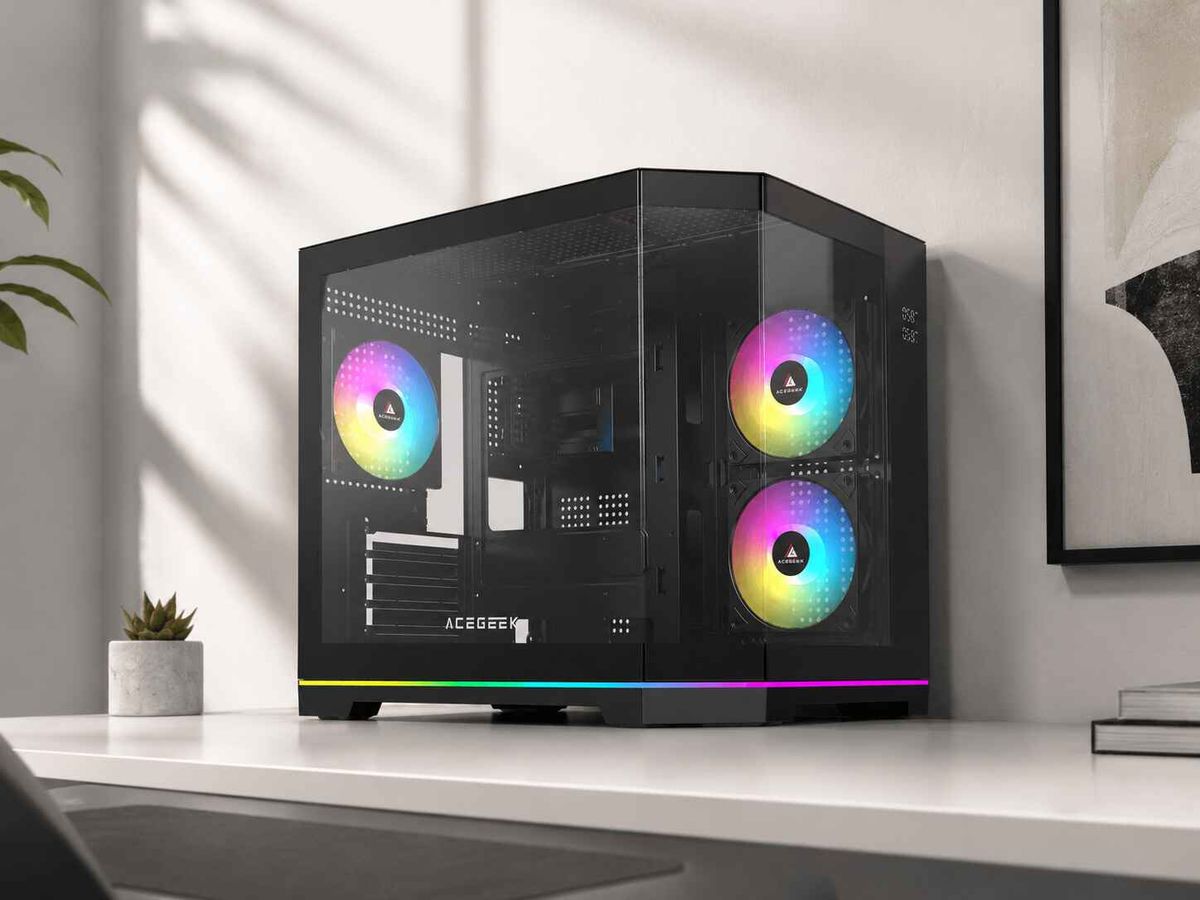
How to Clean Tempered-Glass PC Panels Without Streaks
Streaks are optional.
Most cloudy PC panels are not suffering from damaged glass; they are covered by excess cleaner, tap-water minerals, fabric-softener residue, redistributed fingerprints, or lint left behind by a cloth that was never genuinely clean.
So why do people keep adding more spray?
The hard truth is that cleaning tempered glass is usually less about chemical power and more about controlling contamination. Use too much product, and you create a film. Use the same cloth for washing and drying, and you spread that film. Clean the panel while it is warm, and the liquid evaporates before you can remove it.
My rule is blunt: use the weakest method that removes the mark, then stop.
Why Tempered-Glass PC Panels Develop Streaks
A streak is normally a thin, uneven layer of material left on the surface after wiping. That material may include skin oil, detergent, dissolved minerals, dust, fragrance additives, silicone, wax, or fibers from the cleaning cloth.
The glass itself is rarely the problem.
The National Glass Association’s technical guidance describes uncoated glass as a smooth, non-porous surface that can withstand repeated cleaning with many cleaning agents. But a PC side panel is not always just bare glass. It may also include a black printed border, tint, anti-smudge treatment, adhesive trim, rubber mounting pads, painted hardware, or plastic clips.
That distinction matters.
A chemical may be harmless to plain glass while still affecting the materials attached to it. This is why I do not recommend flooding a PC panel with ordinary household glass cleaner simply because the bottle says “safe for glass.”
The five most common causes of streaks
Too much cleaning solution: The liquid evaporates, but surfactants and additives remain.
Hard tap water: Calcium and magnesium deposits create cloudy spots and drying marks.
One-cloth cleaning: The cloth becomes loaded with oil and then redistributes it.
Dirty microfiber: Dust, old polish, detergent, or fabric softener contaminates the surface.
Cleaning warm glass: Rapid evaporation prevents an even final wipe.
Fingerprints are especially stubborn because they contain oils rather than simple dry dust. Water alone may move the oil without fully lifting it. More water does not solve that. A tiny amount of mild surfactant does.
The Best Cleaner for Tempered-Glass PC Cases
For routine tempered glass side panel cleaning, start with distilled water and two genuinely clean microfiber cloths. One cloth removes contamination. The other dries and polishes.
Do not combine those jobs.
Cleaner or ToolBest UseStreak RiskMy VerdictDry, clean microfiber clothLoose dust and very light fingerprintsLowBest first stepDistilled waterDust, light smudges and final rinsingVery lowBest routine cleaner250 mL distilled water plus 1–2 drops of pH-neutral dish soapOily fingerprints and stubborn hazeLow when rinsedBest general-purpose mixture70% isopropyl alcohol on a clothSpot treatment on confirmed bare, uncoated glassMediumUse selectivelyCommercial glass cleanerPlain glass when approved by the case manufacturerMedium to highConditionalAmmonia-based cleanerHeavy household glass cleaningHigh around coatings, print and adhesivesUsually unnecessaryWhite vinegar solutionMineral residue on plain glassMediumNot my first choicePaper towelsQuick wipingHigh lint and residue riskAvoidAbrasive pad or melamine foamScrubbingHigh damage riskNever use
My recommended streak-free PC case glass cleaner
Mix:
250 mL of distilled water
One or two drops of mild, pH-neutral dish soap
That is enough.
More soap does not create more cleaning power in this application. It creates more residue that must be removed. After the oily marks are gone, wipe the panel once more with a second cloth lightly dampened with plain distilled water, then dry it immediately.
For isolated adhesive residue or a particularly greasy fingerprint, 70% isopropyl alcohol—C₃H₈O—can be used sparingly on confirmed bare glass. Apply it to the cloth, not directly to the panel. Keep it away from printed graphics, tint films, painted edges, adhesives, rubber mounts and unknown surface treatments.
The National Glass Association has documented the use of 70% isopropyl alcohol on appropriate glass barriers, but compatibility with adjacent materials still needs to be considered. A PC panel is a mixed-material component, not a laboratory glass plate.
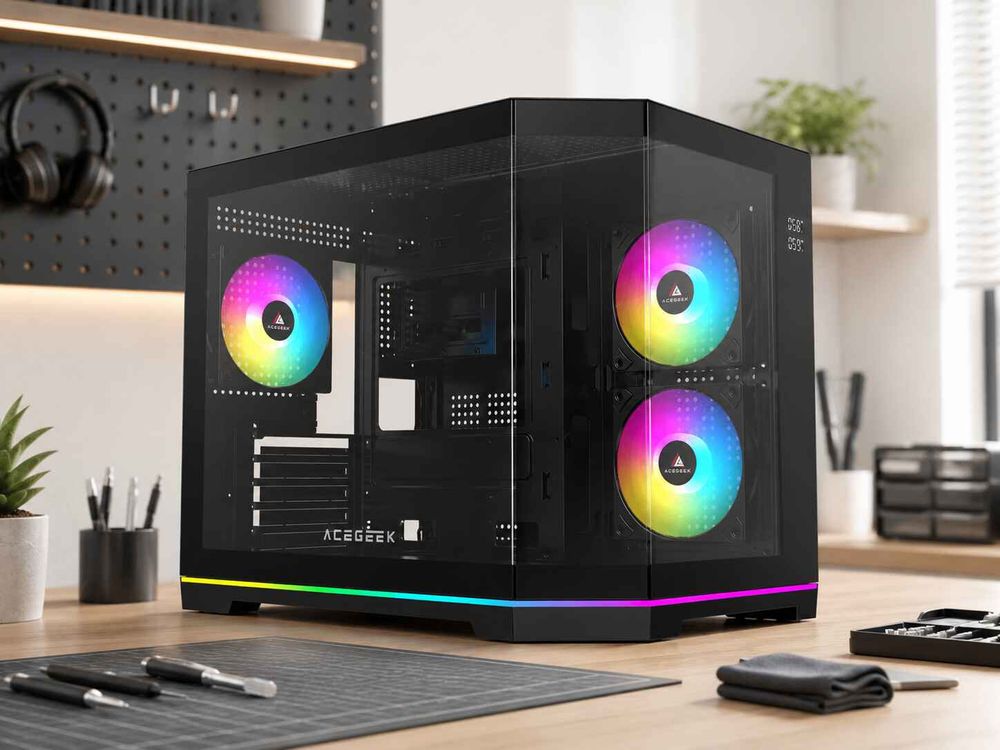
How to Clean a Tempered-Glass PC Case Without Streaks
1. Shut down the PC and let the panel cool
Turn off the system, switch off the power supply and unplug the power cable. Wait approximately 10–15 minutes if the computer has been operating under a heavy gaming or rendering load.
The goal is not merely electrical safety. Cleaning liquid dries too quickly on warm glass, increasing the chance of visible streaks.
Do not remove the panel while the computer is running. Do not spray liquid through a vent. And do not treat a vertical panel attached to a populated case like an ordinary window.
2. Check how the panel is attached
Tempered-glass panels may use:
Rear thumbscrews
Four corner fasteners
Hinges
Magnetic catches
Push-pin mounts
Sliding rails
Tool-free release mechanisms
Support the panel with one hand before releasing the final fastener. Larger panoramic panels should be held with two hands.
Cases with quick-release side panels designed for building and cleaning reduce repeated screw handling and make maintenance less irritating, but “tool-free” does not mean “drop-proof.” Panel weight remains in your hands as soon as the catch releases.
3. Move the panel to a safe work surface
Place a folded, clean towel on a stable wooden, laminate or similarly forgiving worktop. Lay the panel flat unless the manufacturer provides different handling instructions.
Avoid resting a glass edge directly on:
Ceramic tile
Granite
Concrete
Metal
Stone countertops
Loose screws or tools
Tempered glass is stronger than ordinary annealed glass under many loads, but “tempered” does not mean indestructible.
Guardian’s technical data states that fully tempered 6 mm architectural glass is approximately four times stronger than comparable annealed glass and carries more than 10,000 psi of residual surface compression under ASTM C1048. That is useful engineering context, not a specification for every PC panel. Tempered glass stores internal stress, and concentrated damage can still trigger full-panel fracture.
Handle the edges like they matter. They do.
4. Remove loose dust before adding moisture
Use a clean, dry, low-pile microfiber cloth to lift loose dust. Make one light pass across the surface rather than grinding particles around in circles.
Fold the cloth into quarters. This provides several clean wiping faces. When one face becomes dusty, rotate to another.
Do not use the same cloth that cleans your desk, monitor stand, keyboard or case filters. A cloth carrying abrasive particles can convert an easy cleaning job into permanent fine marks.
5. Apply cleaner to the cloth, not the glass
Lightly dampen a second microfiber cloth with distilled water. The cloth should feel damp, not wet enough to drip.
For oily prints, use the diluted dish-soap mixture described above.
Spraying the panel directly creates three problems:
Liquid can run into edge trim or mounting hardware.
Overspray can reach fans, cables, paint or nearby electronics.
Excess product is harder to remove evenly.
This matters even when the glass has already been removed. Controlled application produces controlled results.
6. Wipe in straight, overlapping passes
Use light pressure and straight passes from top to bottom. Overlap each pass slightly.
Circular scrubbing feels productive, but it tends to redistribute oil over a wider area. Straight passes make it easier to see where contamination begins and ends.
For stubborn fingerprints:
Hold the damp cloth against the mark for several seconds.
Wipe once with light pressure.
Rotate to a clean face of the cloth.
Repeat only when necessary.
Do not attack one spot with a fingernail, razor blade, abrasive sponge or melamine foam.
7. Rinse away soap residue
When soap has been used, wipe the surface with a separate microfiber cloth lightly dampened with plain distilled water.
This step is often skipped.
It is also the reason many “clean” panels remain cloudy. The fingerprint may be gone, but the detergent film is still present.
8. Buff immediately with a dry cloth
Use a third clean, dry microfiber cloth—or the untouched dry cloth reserved from the beginning—to polish the panel before the remaining moisture evaporates.
Use long vertical passes on one side and horizontal passes on the other. If a streak remains, its direction reveals which side needs another wipe.
Cheap trick? Yes.
Effective? Also yes.
9. Inspect the panel from several angles
Hold the panel under indirect light and view it from a low angle. RGB lighting inside a case can hide haze that becomes obvious in daylight.
Do not reinstall the panel until:
Both faces are dry
The edges are dry
The mounting holes are clear
The cloth has left no fibers
No liquid remains around printed borders or hardware
Then reinstall the panel without overtightening fasteners. Tighten only until secure, using even pressure where multiple corner screws are present.
Can You Use Ordinary Glass Cleaner on a PC Side Panel?
Yes, sometimes.
A conventional glass cleaner can work on plain, uncoated tempered glass. The problem is not automatically the glass. The problem is everything else built into the panel.
Some products contain ammonia—NH₃—while others contain alcohols, fragrances, surfactants, dyes or anti-static additives. These may leave residue or react with tint films, printing, paint, adhesives and rubber.
The U.S. Environmental Protection Agency also notes that volatile organic compounds in cleaning products can affect indoor air quality. For one PC panel, there is little reason to create a cloud of scented solvent when distilled water and a few drops of mild soap normally complete the job.
My decision rule
Use commercial glass cleaner only when all four statements are true:
The case manufacturer does not prohibit it.
The panel has no incompatible coating or tint.
The cleaner is applied to the cloth rather than sprayed around the PC.
You can remove the product completely with a dry finishing cloth.
Otherwise, use distilled water.
Never mix cleaning chemicals
Do not combine ammonia cleaner, bleach, vinegar, alcohol or other household products.
The U.S. Centers for Disease Control and Prevention states that household bleach commonly contains 5–9% sodium hypochlorite—NaOCl—and specifically warns against mixing bleach with ammonia or other cleaners. A PC side panel does not require disinfection with bleach in the first place.
Keep chemistry boring.
Why Your PC Case Glass Still Looks Cloudy
Your microfiber cloth contains fabric softener
Fabric softener deliberately leaves material on fibers. That is the opposite of what a glass-polishing cloth needs.
Wash microfiber separately using a small amount of fragrance-free detergent. Do not use:
Fabric softener
Dryer sheets
Bleach
Heavy fragrance boosters
Wax-based laundry additives
Air-dry the cloth or use a low-heat setting if its care label permits.
You are using tap water
Tap water may look clear while carrying dissolved minerals. When the water evaporates, the minerals remain.
Distilled water—H₂O with most minerals removed—is inexpensive and predictable. For PC case glass, predictability beats convenience.
You are using too much dish soap
One or two drops per 250 mL is enough for a lightly soiled side panel. A large squeeze from the bottle produces a detergent layer that requires repeated rinsing.
More bubbles mean more work.
You are cleaning in direct sunlight
Direct sunlight heats the surface and accelerates evaporation. Clean the panel indoors under cool, indirect light.
You are polishing with the contaminated side of the cloth
Once a cloth face has lifted fingerprints, it is no longer a finishing surface. Refolding the cloth is not obsessive. It is contamination control.
A Maintenance Schedule That Prevents Heavy Buildup
A side panel is easier to clean when fingerprints and dust have not been baked into layers of household grime.
I would use this schedule:
Every two to four weeks
Inspect the glass for fingerprints and haze.
Wipe the exterior with a dry microfiber cloth.
Inspect intake filters.
Check whether dust is accumulating around panel gaps.
Every two to three months
Shut down and unplug the system.
Remove the glass panel.
Clean both sides separately.
Clean removable dust filters.
Inspect fans, radiator fins and ventilation openings.
Check CPU and GPU temperatures against earlier readings.
After upgrades or cable work
Remove handling prints before reinstalling the panel.
Check that no cable is pushing against the glass.
Confirm that gaskets and fasteners are seated correctly.
Avoid touching the viewing area during reassembly.
ACEGEEK’s comparison of black and white PC cases during long-term ownership recommends inspecting filters every two to four weeks and checking fans, radiator fins and GPU heatsink surfaces every two to three months. The exact interval still depends on pets, carpet, smoke, open windows and floor-level placement.
White systems expose contamination sooner, which is not entirely bad. The white PC case cleaning and component-matching guide explains why visible dust can encourage maintenance before filters and heatsinks become heavily restricted.
Glass Maintenance Starts With Case Design
Cleaning technique matters, but access determines whether the work gets done.
A large tempered-glass panel trapped between a wall and a desk is going to be neglected. A hinged or quick-release panel with removable filters is more likely to receive regular maintenance.
This is especially relevant to showcase builds. The comparison of mesh, glass and closed PC case designs shows that glass-heavy cases often rely on side or bottom intake rather than an open front. Those additional surfaces, vents and filters create more maintenance points.
And panoramic cases magnify every fingerprint. Before building one, review the practical issues in panoramic PC case layouts and dual-chamber designs. A clean viewing chamber is useful only when the hidden chamber, airflow path and maintenance access are also planned properly.
My opinion is simple: a beautiful PC case that is difficult to clean has an incomplete design.
FAQs
How do you clean a tempered-glass PC case without streaks?
To clean a tempered-glass PC case without streaks, remove the cool, unplugged panel, dust it with a clean microfiber cloth, wipe it with a second cloth lightly dampened with distilled water, and immediately buff the surface dry using straight overlapping passes rather than circular scrubbing.
For oily marks, add one or two drops of pH-neutral dish soap to 250 mL of distilled water. Follow with a plain distilled-water wipe so no detergent film remains.
What is the best cleaner for tempered-glass PC case panels?
The best cleaner for a tempered-glass PC case is distilled water for routine marks, followed by a highly diluted pH-neutral dish-soap solution for oily fingerprints, because this combination minimizes mineral deposits, surfactant film, overspray, and chemical exposure to printed borders, coatings, rubber mounts, and painted metal.
Use separate microfiber cloths for washing, rinsing and drying. The cloth condition matters as much as the cleaning liquid.
Can you use glass cleaner on a tempered-glass PC case?
You can use glass cleaner on a tempered-glass PC case only when the panel manufacturer permits it and the product is compatible with any tint, printed border, anti-smudge coating, adhesive, rubber gasket, and nearby paint; spray the cloth rather than the panel and use the smallest practical amount.
For most routine cleaning, distilled water is enough. Commercial cleaner adds ingredients that must later be removed.
How do you remove fingerprints from PC case glass?
To remove fingerprints from PC case glass, first lift loose dust with a dry microfiber cloth, then wipe the oily area with distilled water containing one or two drops of pH-neutral dish soap per 250 mL, follow with a distilled-water rinse cloth, and polish immediately with a separate dry cloth.
Do not repeatedly scrub the fingerprint with a dry cloth. That spreads the oil and can drag dust across the glass.
Can you clean a tempered-glass PC panel with paper towels?
Paper towels are a poor choice for tempered-glass PC panels because they can shed lint, drag trapped grit across the surface, and encourage users to add more cleaner when the real problem is residue; a clean, low-pile microfiber cloth provides more controlled pickup and a cleaner final polish.
Paper towels may appear clean under room lighting while leaving fibers that become obvious once the PC’s internal lighting is switched on.
How often should you clean a tempered-glass PC side panel?
A tempered-glass PC side panel should be cleaned whenever fingerprints or haze become visible, while exterior dust can be checked every two to four weeks and deeper case maintenance performed every two to three months, with shorter intervals for floor-level systems, pets, smoking, open windows, or construction dust.
Cleaning frequency should follow actual contamination rather than a rigid calendar. Filter loading, fan noise and temperature changes are useful warning signs.
Can you use 70% isopropyl alcohol on tempered glass?
Seventy-percent isopropyl alcohol can spot-clean plain, uncoated tempered glass, but it should not be the default cleaner for every PC panel because printed graphics, tint films, anti-smudge layers, adhesives, rubber parts, and painted edges may react differently; test a hidden area and apply alcohol only to the cloth.
Use it for isolated oily or adhesive residue, then finish with distilled water and a dry microfiber cloth.
Keep the View Clear
Clean the panel with less product, not more.
Shut down the PC. Remove the glass carefully. Use distilled water, a tiny amount of mild soap when needed, and separate microfiber cloths for cleaning and drying. Keep aggressive chemicals away from coatings, printing and mounting materials.
And when choosing your next chassis, compare the ACEGEEK PC case range for tempered-glass, panoramic, airflow and quick-access designs that make routine maintenance easier rather than turning every cleaning session into a disassembly project.