One-Piece Curved Glass: What Buyers Should Check Before Ordering
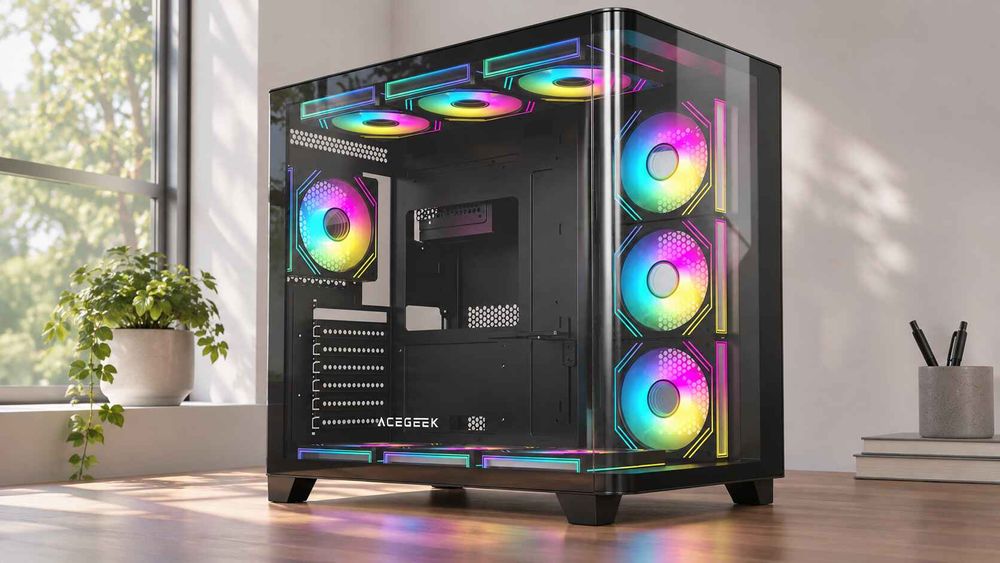
A one-piece curved glass panel wraps the front corner and side of a PC case in a single bent sheet. There is no vertical pillar to break the view of the hardware. The look is why many brands add curved-glass "seaview" or panoramic cases to a line-up. It also moves risk to the supplier and the buyer. Curved panels are harder to make consistently, harder to ship, and harder to replace than flat panels. Many product pages show only the render and the chassis dimensions. The decisions that determine returns and margin sit in the glass specification, the distortion limits, the retention design and the packaging. This guide covers what distributors, importers and OEM/ODM brand owners should verify before they approve a sample or release a purchase order.
What Does "One-Piece Curved Glass" Mean in a PC Case?
In a PC case, one-piece curved glass means a single bent tempered glass panel. It covers an area that other designs split into two flat panels, such as the front and the side. Exact geometry varies by model. Some cases curve only one corner, and others wrap further around. Always confirm the panel shape against the drawing, not the marketing name.
Curved glass is normally shaped by hot bending. An architectural glass manufacturer's overview of hot bending and cold bending describes heating glass until it conforms to a mold. It also explains that mold quality and process control affect distortion, and that quality checks follow bending. That source covers architectural glass, and PC case panels are smaller and usually thinner. The logic still carries over. The mold, the heating process and the inspection method decide whether the second panel off the line looks like the first.
For a buyer, the practical point is that the curve is a manufactured feature with its own tooling and yield. It is not a styling option with the same cost as a flat panel.
Is One-Piece Curved Glass Always Better Than Two Flat Panels?
No. One-piece curved glass is better when an uninterrupted view of the hardware is the product's main selling point. Two flat panels are often the lower-risk choice when margin, shipping damage or spare-part logistics matter more. The two options trade off as follows.
One-piece curved glass
Visual: continuous view with no pillar, and the strongest display effect.
Manufacturing: needs bending molds and has a higher scrap risk. Reflection distortion is harder to control.
Breakage and replacement: one break means replacing the whole panel, which is large and costly to stock.
Assembly: the curved edge must seat evenly against the frame, so fit tolerances are tighter.
Shipping: needs custom protection for the curve and corners, and the carton is usually bulkier.
Two flat panels
Visual: a visible joint or pillar between the panels, which some buyers see as less premium.
Manufacturing: flat tempered glass is a mature process with simpler inspection.
Breakage and replacement: a single panel can be replaced, so spares are smaller and cheaper.
Assembly: flat edges are easier to align.
Shipping: easier to pack and stack.
This table-free summary reflects qualitative reasoning, not measured data. Actual cost and defect rates depend on the supplier.
One assumption deserves qualification. More glass is not automatically a better product. A buyer selling to enthusiasts who want a showpiece build can justify the added cost. A buyer selling volume into price-sensitive channels may find that the curved panel's scrap, spares and freight volume absorb the premium. Buyers weighing other front-panel approaches can read this comparison of mesh, glass and closed PC case designs to see where each fits.
What Glass Specifications Should Buyers Request?
Request the glass thickness, the tempering method, the edge finish, and whether the panels are heat soaked. A product page that shows only the render does not give you these details. Put all four into the RFQ and the purchase specification.
Thickness, Tempering, and Edge Finish
Thickness affects strength, weight and how the panel fits its retention hardware. Thicker glass is not automatically better. A heavier panel loads the hinges, clips or magnets more, and it adds shipping weight. Ask for the nominal thickness and the allowed variation.
On tempering, the European standard EN 12150-1 covers thermally toughened soda lime silicate safety glass. Ask which standard the supplier tests against and whether the test covers bent panels. Do not assume that a flat-glass standard's limits apply to a curved part without confirmation.
Edge finish matters because chips and corner damage start at the edges. Ask whether edges are ground or polished, and how the corners are finished. Compare the supplier's answers with the guidance in this tempered glass PC case safety guide on thickness, edges and placement.
Heat Soaking: What It Can and Cannot Do
Heat soaking is a test that holds tempered glass at an elevated temperature to provoke breakage in panels that contain nickel sulfide (NiS) inclusions. A glass industry technical bulletin on heat soak testing explains that the process reduces but does not eliminate the risk of spontaneous breakage. It also notes that North America has no standard for heat soak testing, and that EN 14179-1 requires all panes to be heat soaked.
That scope is architectural. Whether heat soaking is common in PC-case glass was not verified. For buyers, the useful question is whether the supplier heat soaks, to what cycle, and whether every panel or only samples are tested. Heat soaking adds cost and lead time, so expect it to appear in the quote.
How Can Buyers Judge Curvature and Optical Distortion Before Mass Production?
Approve a physical golden sample, and agree limit samples, before mass production. Photos and renders cannot show reflection distortion.
A glass industry article on optical distortion in tempered glass explains that tempered glass is not as flat as annealed glass. Typical causes include bow, roller wave and edge lift, and the article recommends mock-ups to judge the result. Curved panels add the bend on top of those effects.
A practical approval process looks like this:
Fix a viewing setup: the same lighting, distance and angle for every inspection.
Look at the reflection of straight lines, such as a window frame or a ruled grid, across the curve. Wavy lines indicate distortion.
Agree three reference samples: acceptable, borderline and reject. Keep them at both the supplier and the buyer.
Check the fit of each sample on a real chassis. Look at the gap between glass and frame along the curve and at the corners.
Repeat the check on a production-run sample, not only the pre-production sample.
Do not invent a distortion tolerance. Ask the supplier what measurement method and limit they use, and compare it with your own samples.
Does the Glass Decide the Airflow?
No, but it decides where air can enter. A large glass area removes metal or mesh that would otherwise admit air, so the intake paths must be built elsewhere.
A 2020 review by GamersNexus gives a useful reference, though it covers a flat-panel case, not a curved one. In its Corsair 4000D and 4000D Airflow review, the two variants differed only in the front panel and used the same fans. The CPU averaged 59°C above ambient with the closed front and 50°C with the perforated front. The GPU averaged 55°C and 51°C. The result shows that panel openings matter, but it says nothing about any curved-glass design.
For a curved seaview case, ask the supplier where the intake and exhaust paths are, and how many fan positions are available. Buyers can read more about how to balance aesthetics and cooling in tempered glass PC cases. The panoramic PC case build guide covers practical points that end customers will face. Ask the supplier for thermal test results on the actual model, with the test conditions stated.
How Should the Panel Be Retained, Handled, and Shipped?
The panel should be held so that glass never loads directly against bare metal, and the carton should protect the curve and corners. Ask for both to be documented.
On retention, ask whether the panel uses screws, clips, magnets or a combination, and what cushions sit between glass and frame. Removal affects both builders and returns, because a panel that is awkward to take off is more likely to be dropped. This article on quick-release PC case panels for building and cleaning covers the user-side benefits. For a buyer, the question is whether the retention design still protects the glass when the panel is removed and refitted repeatedly.
On shipping, check the following:
Corner and edge protection inside the carton, and separation of the glass from the metal chassis.
Whether the carton has been drop-tested and under what protocol. Agree the test method in advance, instead of accepting a generic statement.
How the carton holds up in palletized and container loading.
Who bears the cost of breakage in transit, and how claims are documented.
What Drives the Cost, and How Should You Plan MOQ and Spares?
The main cost drivers are bending tooling, scrap and yield loss, heat soaking, inspection, packaging and freight volume. Curved-glass cases usually cost more to ship per unit than flat-panel cases because of the larger, more protective carton.
Plan MOQ and spares together. A bending mold is a fixed cost, so a small first order spreads it across few units. Ask whether the MOQ applies per color and per model. Also agree a spare-glass quantity in the contract, since a replacement curved panel cannot be sourced locally. Do not accept a spare allowance that exists only in conversation.
Illustrative example (not a real case). Quote A has the lower unit price, but it leaves out heat soaking, offers no spare panels, and uses a single-wall carton. Quote B has the higher unit price, but it includes heat soaking, an agreed spare allowance and reinforced corner packaging. If transit breakage or field failures are higher with Quote A, the lower price can cost more once replacements, returns and customer-service time are counted. Compare quotes on total landed cost, not unit price.
Does the Chassis Specification Match the Glass Design?
Check that the chassis supports the builds your customers will attempt. The glass design is only one part of the product. The CurveX curved glass seaview case lists the following on its product page:
Motherboard support: ATX, M-ATX and ITX.
Case size: 450 × 280 × 435 mm.
Material: 0.7 mm SPCC steel.
Maximum GPU clearance: 410 mm, and CPU cooler clearance: 165 mm.
Radiator support: 360 mm at the top and the side.
Fan positions: 120 mm fans at the top, side, rear and bottom.
The page does not list glass thickness, tempering process, edge finish or panel retention. Its page metadata also showed the product as out of stock when checked. Treat those items as questions for the supplier and put them in the RFQ. Confirm availability before committing to a launch plan.
What Should Buyers Specify Before Requesting a Quote?
A complete RFQ lets the supplier quote the real product, not a minimum one. Include the following:
Panel geometry: the drawing or 3D file, including the curve radius and the panel outline.
Glass thickness and allowed variation: the nominal value and the tolerance you will accept.
Tempering standard: the standard the glass must meet, and the test report you expect.
Heat soaking: required or not, and whether on every panel or by sample.
Edge and corner finish: ground or polished, and the corner treatment.
Tint and coating: clear or tinted, and any coating requirements.
Distortion acceptance: the golden sample, the limit samples and the inspection method.
Retention and cushioning: the retention method and the materials in contact with the glass.
Packaging and transit testing: the carton design, the test protocol and the breakage-claim terms.
Quantity, MOQ and spares: order volume per model and color, plus the spare-glass allowance and delivery schedule.
Ask for the quote to be itemized, so that glass, heat soaking, packaging and spares can be compared line by line across suppliers.
Frequently Asked Questions
What is a one-piece curved glass PC case?
It is a PC case with a single bent tempered glass panel wrapping a corner and side, in place of two flat panels. Exact shape varies by model, so verify the panel geometry against the drawing before ordering.
Is curved tempered glass less safe than flat tempered glass?
Not necessarily, but it is harder to verify. Tempering quality, edge finish and heat soaking all affect breakage risk. Ask which standard and test method the supplier uses for bent panels, since flat-glass standards may not apply directly.
Does heat soaking eliminate spontaneous glass breakage?
No. A glass industry bulletin states that heat soaking reduces the risk of nickel sulfide-related breakage but does not eliminate it. Ask whether the supplier heat soaks, to what cycle, and whether all panels or only samples are tested.
How do I check for optical distortion in curved glass?
Approve a golden sample and agree limit samples before production. Inspect reflections of straight lines across the curve under fixed lighting and angle. Repeat the check on production-run samples, not only the pre-production sample.
Does a glass side panel hurt PC case cooling?
It can, if it replaces openings that would admit air. In one 2020 flat-panel test, a closed front ran warmer than a perforated front with identical fans. Ask for thermal data on the actual model.
What should I plan for MOQ and spare panels with curved glass?
Plan for a mold-related MOQ that may apply per model and color. Agree a written spare-glass quantity, since replacements cannot be sourced locally. Compare quotes on total landed cost, including packaging, spares and freight.